
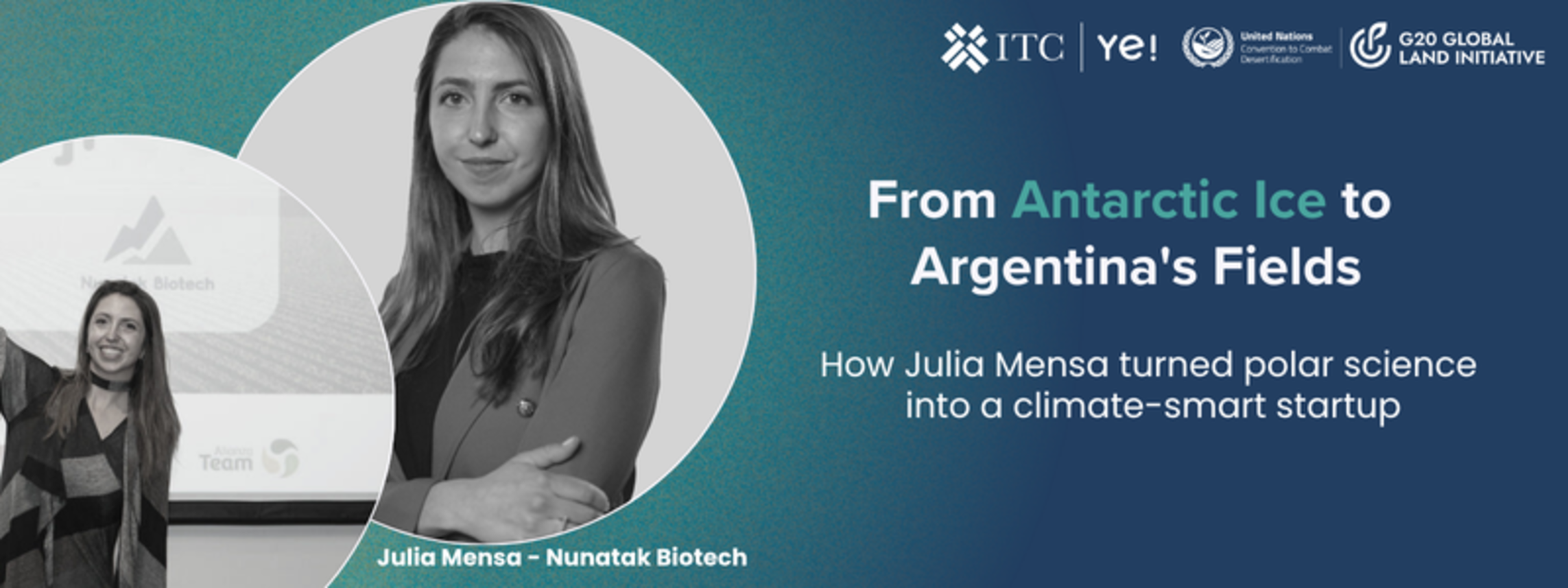
From Antarctica to Agriculture: A YECO Alum’s Microbial Solution
From Antarctica to Agriculture: A YECO Alum’s Microbial Solution
Some of the toughest life on Earth hides in the ice of Antarctica. For more than twenty years, a group of Argentine scientists studied the microorganisms that survive and actually thrive in temperatures that drop below minus fifty degrees Celsius. Those microbes carried secrets about adaptation that most of us can only imagine.
Julia Mensa and her co-founders decided those secrets shouldn’t stay locked in the ice. Less than three years ago they turned that polar research into Nunatak Biotech, a young company that takes extremophile bacteria and turns them into practical tools for farmers facing the very stresses climate change is making worse ,drought, salinity, extreme heat, poor soils.
Their first product is straightforward: a liquid microbial inoculant that farmers can apply to seeds or leaves. It doesn’t replace existing fertilizers or chemicals. Instead, it works alongside them. The microbes help plants tolerate stress better while staying compatible with both chemical and biological inputs. That compatibility is deliberate. Julia explains that many large companies already have strong commercial channels and established portfolios; Nunatak’s role is to slip in and make those products more resilient without forcing anyone to change how they work.
The early field results in Argentina have been encouraging. Farmers using the inoculant at roughly five dollars per dose are seeing yield improvements that translate into seven to nine times return on their investment. Production costs sit at only 16–17 percent of the final product, leaving healthy margins even at small scale. The company has already validated the solution on wheat, barley, corn, soy, and pastures, with potato trials coming next.
Right now Nunatak is still pre-revenue. They have filed a provisional patent and the product is moving through registration in Argentina and other markets ,a process that usually takes one to two years. But the momentum is real. They already have a corporate partnership in the United States, active testing with input companies and food processors in Argentina, and plans to launch trials soon in Mexico and, hopefully, Europe.
Julia is quick to say the journey has been accelerated by the right connections at the right time. Through the Youth Ecopreneur Programme she was able to join a specialized salinity workshop in Dubai that helped validate their hypothesis for arid regions like Saudi Arabia and the Emirates. At COP16 they stood in rooms with international organizations and land-restoration experts, getting a much bigger picture of the challenges and opportunities ahead. Later trips to the Start Summit in Switzerland and ChangeNow in Europe opened doors to investors and companies serious about sustainable food production. Another stepping stone for her was participating in Meet the Drapers, a televised global pitch competition with a reach of over 30 million viewers, hosted by venture capitalist Tim Draper. In its regional rounds, entrepreneurs from around the world participate in a unscripted pitch competition reality show. One participant from each round gets to go to Silicon Valley for a chance to win 1 Million USD investment alongside mentorship. Julia was among the 4 finalists for the Argentinean rounds. One of the judges while noting the right moment for such technologies remarked Nunatak to be one of the most disruptive cases.
“Connections are everything,” she says. The programme gave her peers and mentors across continents who understand both the science and the hard realities of scaling a climate-smart solution from lab to field.
From the frozen extremes of Antarctica to the fields of Argentina and beyond, Nunatak Biotech is showing that some of the best answers for tomorrow’s farming were waiting in the planet’s harshest places all along. Julia Mensa and her team are turning decades of polar research into something farmers can actually use ,one stress-tolerant microbe at a time ,while keeping the business model grounded in partnership rather than disruption.
Julia is a Youth Ecopreneur Programme Alumni, to be part of the next cohort please express your interest here.
Interview conducted and written by Hassan Alam and graphics designed by Sabina Patrascu (UN Volunteers)